27 August 2026
Blocking Before It Happens: How Anthropic, Cursor and OpenAI Handle Inline AI Governance
A comparison of Anthropic's cloud webhooks, Cursor's process hooks and OpenAI's gateway proxy for enterprise AI governance.
27 August 2026
A comparison of Anthropic's cloud webhooks, Cursor's process hooks and OpenAI's gateway proxy for enterprise AI governance.
AI security is finally shifting from “audit after the fact” to “block before it happens”. That is a meaningful change, because most enterprise AI risk does not arrive neatly packaged in a monthly report. It arrives one prompt at a time: a public servant pastes draft cabinet material into a chat window, a developer embeds an API key in a prompt, or an autonomous agent tries to exfiltrate source code. The major platforms are now offering different architectural answers to the same question: can we intercept the inference itself?
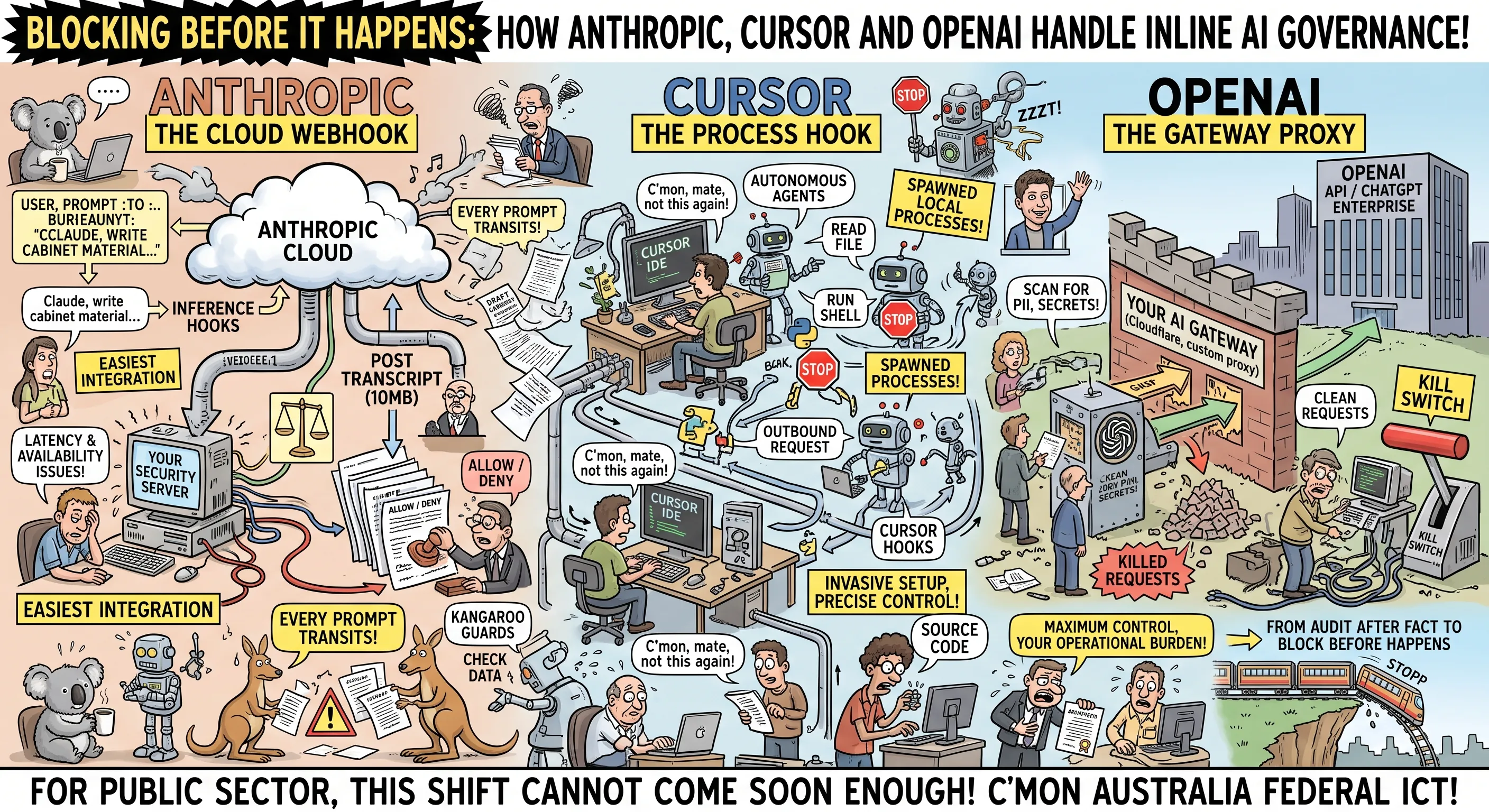
Here is how Anthropic, Cursor and OpenAI are approaching inline governance today, and what it means for teams operating inside the Australian Federal landscape.
Anthropic recently launched Inference Hooks, and they work exactly as the name suggests. When a user sends a prompt, Claude pauses inference and POSTs the transcript (up to 10MB) to an internal security server of your choosing. Your endpoint evaluates the payload and returns a simple allow or deny.
The model is clean because it is cloud-side and centralised. It covers Claude web, desktop and CLI without needing to instrument every endpoint. For Federal organisations that already have DLP, SIEM or classification tooling running in the cloud, this is the easiest integration story: one hook, one policy engine, one place to enforce rules.
There is an important caveat for Federal readers: Inference Hooks do not currently cover Claude accessed via Amazon Bedrock, Google Vertex AI, or voice mode. Given that many Australian Government users reach Claude through IRAP-assessed cloud channels such as Bedrock, this is a meaningful gap. A team routing Claude traffic through Bedrock today would not get Inference Hooks protection at all, and would need a separate gateway or proxy control instead.
The trade-off is exactly what you would expect. Every prompt transits your network, so latency and availability now depend on your endpoint. And because the entire transcript is forwarded, the security server itself becomes a sensitive aggregation point that needs hardening and clear data retention rules.
Cursor takes an agent-first approach with Cursor Hooks. Instead of an HTTP webhook, these are spawned local processes, written in Python, Bash or whatever your team prefers, that communicate over stdio using JSON. You map them to specific agent actions, such as reading a file, running a shell command or making an outbound request, and they decide whether the operation proceeds.
This is a different granularity. Anthropic governs at the prompt; Cursor governs at the action. For autonomous coding agents, where the risk is not just what the model says but what it does next, process-level hooks are the right abstraction. Enterprise teams can enforce them globally via MDM or cloud dashboards, so they cannot be bypassed by a local settings change.
For Federal development teams, this matters because code is a high-value target. A single agent with file-system and shell access can do a lot of damage quickly. Cursor’s model lets you wrap every tool invocation in policy, which is more invasive to set up but far more precise.
OpenAI does not currently offer a native inline hook for the API or ChatGPT Enterprise. If you want pre-inference blocking for OpenAI traffic, the practical path is an external AI Gateway: Cloudflare, Portkey, or a custom reverse proxy that you operate yourself.
The gateway sits between your users and the API, scans for PII, secrets or policy violations, drops offending payloads, and forwards clean requests. It works, but it is infrastructure you have to own. That means latency, scaling, certificate management, logging and another place to monitor.
In a Federal context, this is not a deal-breaker, but it is a procurement and engineering decision. You need to be confident in the gateway vendor’s security posture, or comfortable running your own. Either way, the responsibility for the kill switch is yours, not OpenAI’s.
The three approaches map to three different risk profiles:
None of these are a complete security program on their own. Inline governance is a control, not a strategy. It needs to sit alongside classification guidance, least-privilege access, human review for high-risk outputs, and continuous monitoring.
But the direction is encouraging. We are moving from asking “what did the model say last month?” to “should this prompt leave the building at all?”. For public sector environments where data sovereignty, classification and accountability are non-negotiable, that shift cannot come soon enough.